
The Ultimate 2026 Guide to ISO 17712: Why High Security Seals Are Your Best Defense Against a $725M Cargo Theft Crisis
If there is one harsh lesson the global logistics industry has learned by Q2 of 2026, it is this: distance equates to vulnerability. With geopolitical tensions continuing to disrupt traditional maritime chokepoints like the Red Sea, global supply chains remain stretched. Vessels are heavily favoring the longer, costlier Cape of Good Hope routes. This extended exposure—combined with longer wait times at transshipment hubs—has created an unprecedented, lucrative window for highly organized cargo crime syndicates.
In this high-risk environment, securing your shipping containers is no longer a matter of simply deterring an opportunistic thief in a truck stop; it requires industrial-grade, internationally audited physical and digital protection. Enter the absolute necessity of the ISO 17712 standard and the modern high security seal.
🚨 Real-Time Data: 2025/2026 CargoNet Supply Chain Threat Report
According to the latest intelligence released by Verisk CargoNet for early 2026, the nature of supply chain crime has shifted from opportunistic to highly strategic. While the total number of theft incidents remained relatively stable, the financial impact surged by an astonishing 60%, pushing estimated supply chain losses to a staggering $725 million.
- The Average Loss: The average value per theft incident has skyrocketed to $273,990.
- Top Targets: Thieves have heavily pivoted toward high-demand commodities. Metal theft (driven by copper demand) rose by 77%, and food/beverage thefts spiked by 47%. Enterprise computing hardware has also become a top-tier target.
- The Method: Syndicates are using "strategic theft" (fictitious pickups, digital impersonation, and fraudulent platform activity) to bypass standard padlocks and low-grade seals without leaving obvious visual damage.
What Exactly is the ISO 17712 Standard?
The ISO 17712 standard is the internationally recognized benchmark for mechanical freight container seals. Developed and continuously monitored by the International Organization for Standardization, it establishes uniform procedures for the classification, acceptance, and withdrawal of mechanical seals used on freight containers in international commerce.
When sourcing a high security seal, you must understand that not all locking mechanisms are created equal. The standard classifies tamper-evident seals into three distinct categories based on their physical barrier capacity:
| Classification | Seal Type | Characteristics & Use Cases |
|---|---|---|
| (I) Indicative | Light Plastic / Wire Seals | Easily broken by hand or with simple snips. Good for indicating access on low-risk courier totes, but offer absolutely no physical barrier to entry. |
| (S) Security | Medium Duty Seals | Stronger than indicative seals, requiring light tools (like pliers) for removal. Suitable for domestic road transit where the threat level is low to moderate. |
| (H) High Security | Bolt Seals / Heavy Cable Seals | The ultimate standard. Engineered with hardened steel and shatter-resistant polymers. Removable only with heavy-duty, 24-inch bolt cutters. Mandatory for high-value and cross-border maritime shipping. |
The Two Pillars of True "H-Class" Compliance
A common misconception in logistics is that printing an "H" on a piece of plastic makes it highly secure. It does not. A legitimate, globally recognized ISO 17712:2013 certified seal must independently pass two rigorous hurdles:
1. Clause 5 (Physical and Mechanical Testing): Independent, ISO/IEC 17025-accredited laboratories must torture the seal. The seal undergoes intense tensile (pull) testing, shear testing, bending, and severe temperature impact tests. To earn the "H" rating, a bolt seal must withstand over 1,000 kg (approx. 2,204 lbs) of sheer pull force without breaking.
2. Clause 6 (Tamper Evidence capability): Brute force isn't the only threat; sophisticated thieves use heat, freezing chemicals, and rapid spinning techniques to manipulate locking barrels. Clause 6 mandates that the manufacturer undergoes stringent auditing to prove the seal is designed to leave clear, irrefutable visual evidence (tell-tale signs) if someone attempts to compromise it.
Note: Furthermore, ISO 17712 Annex A requires the manufacturer itself to pass facility risk assessments to ensure blank seals cannot be stolen or cloned internally.
Why C-TPAT Compliance Makes High Security Seals Non-Negotiable
If you are shipping goods into the United States, participating in global Authorized Economic Operator (AEO) programs, or navigating the stringent new EU border regulations in 2026, using an ISO 17712 compliant high security seal is a mandatory regulatory requirement, not an option.
Under the U.S. Customs-Trade Partnership Against Terrorism (C-TPAT) guidelines, all loaded containers bound for the US must be secured with a seal that meets or exceeds the "High Security" (H) classification of the ISO 17712 standard. Failure to deploy strictly compliant tamper-evident seals will result in catastrophic supply chain delays, 100% manual cargo inspections at the port of entry, hefty fines, or the outright rejection of your shipment.
2026 Outlook: The Shift to Hybrid "Smart" Seals
As we look at the regulatory landscape for the remainder of 2026, customs authorities are beginning to expect not just physical strength, but digital traceability. With the rise of "fictitious pickups," securing the physical door isn't enough; you must secure the data. This has led to the rapid adoption of RFID container seals (e-seals). These combine the brute mechanical strength of an ISO 17712 High-Security Bolt Seal with an embedded RFID chip, allowing port gates to automatically scan and verify the seal's integrity without human intervention, neutralizing insider threats.
The LeghornGroup Solution: Engineering Unyielding Protection
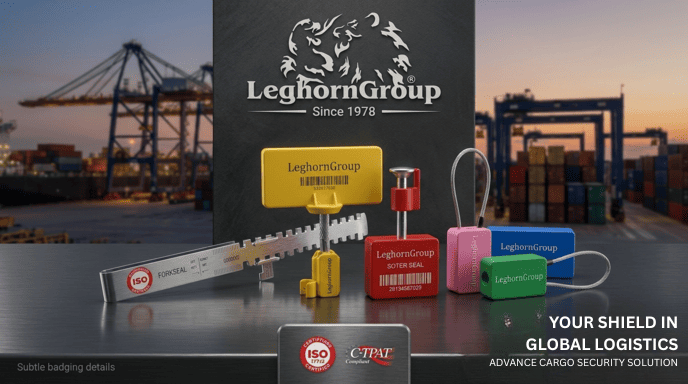
Since 1978, LeghornGroup has engineered anti-tampering solutions that stay one step ahead of organized cargo criminals. To combat the sophisticated, multi-million dollar threats dominating the 2026 logistics landscape, we provide the ultimate barrier: our flagship NEPTUNESEAL.
- Fully Certified Protection: Independently certified to the strict ISO 17712:2013 standard (covering Clause 5, Clause 6, and Annex A).
- Advanced Anti-Spin Mechanism: Engineered to lock firmly into a fixed position. This prevents thieves from using high-speed drills to spin and friction-melt the plastic casing to reach the internal metal pin.
- Absolute Digital Traceability: Every LeghornGroup seal features deeply laser-engraved serial numbering and barcoding that cannot be rubbed off, painted over, or altered, ensuring seamless manifest matching.
- RFID Ready Integration: Available as an advanced RFID e-seal, providing the ultimate "hybrid" compliance for frictionless customs clearance.
Don't Gamble with Your Global Logistics
With cargo theft syndicates operating at peak sophistication and targeting high-value goods like never before, your shipping container seals are your final, most critical line of defense. Ensure your exports are compliant, physically secure, and fully traceable.